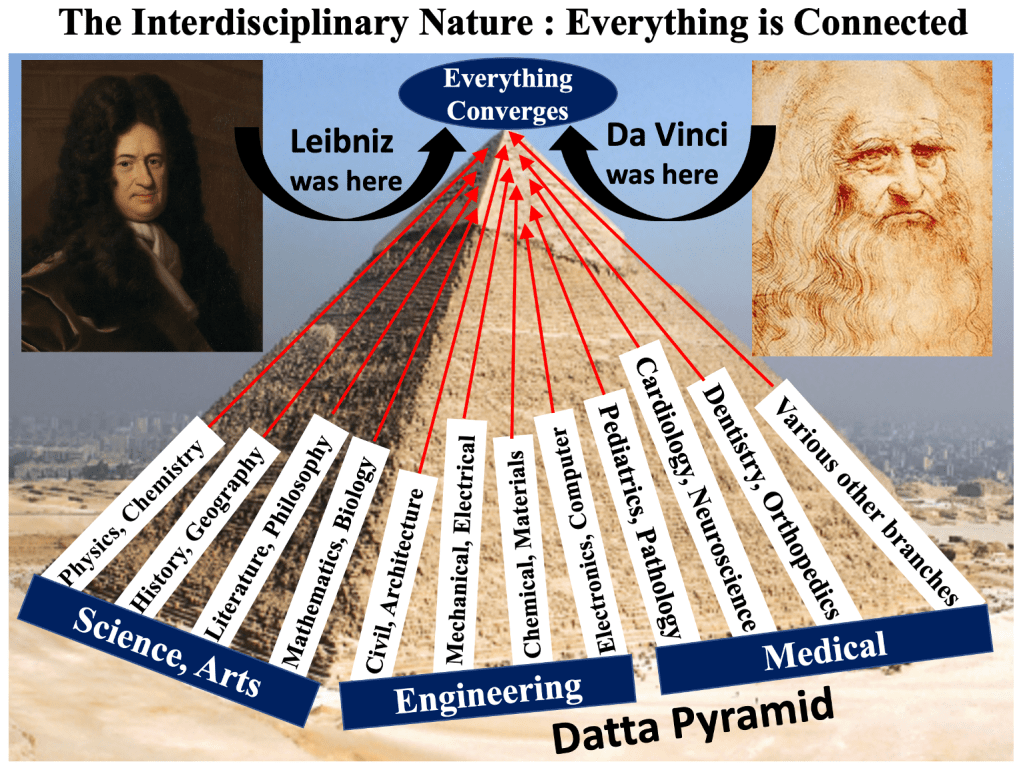
DATTA PYRAMID
Prelude to the upcoming book :
The Interdisciplinary Nature: Everything is Connected
Albert Einstein once remarked, “Everything is connected,” a statement that resonates deeply across the landscape of human knowledge. The upcoming book The Interdisciplinary Nature: Everything is Connected draws inspiration from this timeless insight, embarking on a journey through the tapestry of academic disciplines to uncover the underlying threads that unite them.
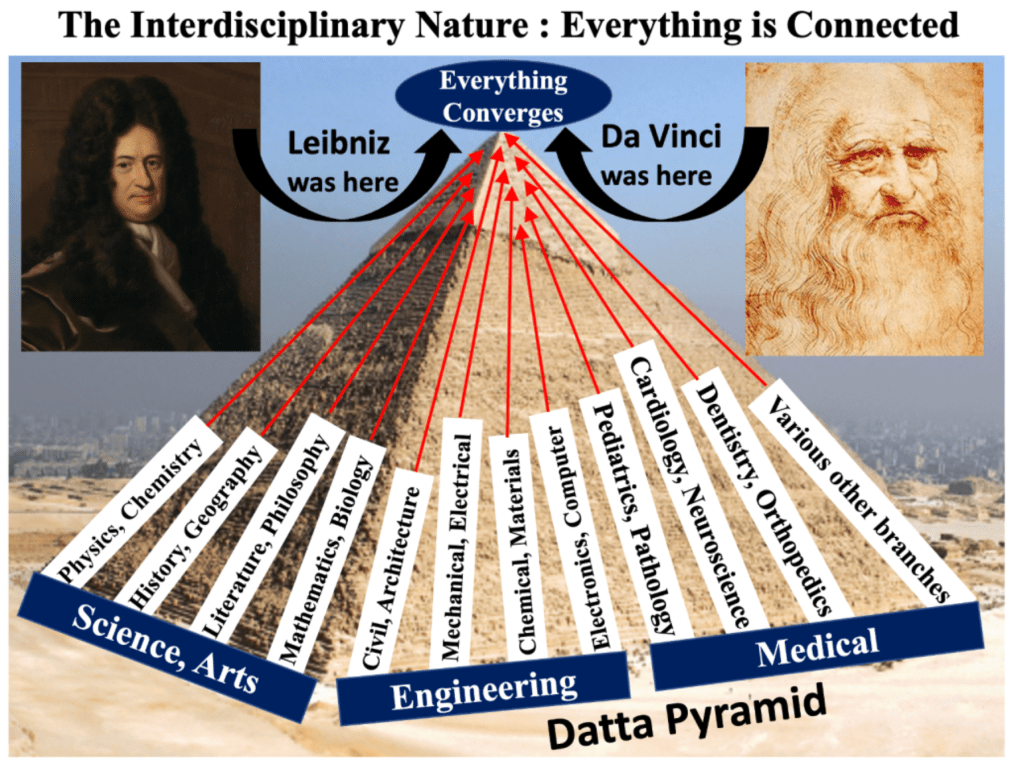
At the heart of this exploration lies the concept of the Datta Pyramid – a philosophical framework introduced by Dibakar Datta. In this model, the base represents the broad spectrum of individual disciplines – from physics, biology, and engineering to philosophy, art, and literature. As one ascends the pyramid, these seemingly disparate fields begin to converge, ultimately meeting at the apex, where a unified understanding of the world emerges. The Datta Pyramid serves as both a metaphor and a roadmap for students, educators, researchers, and thinkers who seek to embrace the richness of interdisciplinary inquiry.
The book will spotlight the lives and contributions of legendary polymaths such as Leonardo da Vinci, Gottfried Wilhelm Leibniz, and others who transcended the boundaries of their time. Their achievements – spanning medicine, mathematics, mechanics, the arts, and beyond – demonstrate that creative genius often arises not from specialization alone, but from the synthesis of diverse perspectives.
Through philosophical reflection, historical narratives, and contemporary examples, the book will illustrate how ideas from one field can catalyze innovation in another. Topics explored include:
- How mathematics underpins music and art through structure, pattern, and symmetry.
- The role of biology in engineering through biomimicry and natural design.
- The intersection of physics and philosophy in understanding the nature of time and reality.
- How language and communication influence scientific discovery.
- The ways in which breakthroughs often emerge from the cross-pollination of disciplines such as computer science, neuroscience, and cognitive psychology.
Moreover, The Interdisciplinary Nature challenges the compartmentalization of modern education. It calls for an educational renaissance – one that empowers learners to cross intellectual borders, connect ideas, and cultivate a mindset that views knowledge not as isolated silos but as an interconnected system.
This book is both a celebration of curiosity and a manifesto for a more integrative intellectual future. It is intended for anyone who believes that true innovation flourishes not in isolation, but in connection.