DDLab Research : Development of Advanced AI Techniques
** MODIFIED HIGH DIMENSIONAL NEURAL NETWORK (MHDNN) FOR THE INTERFACED SYSTEMS **
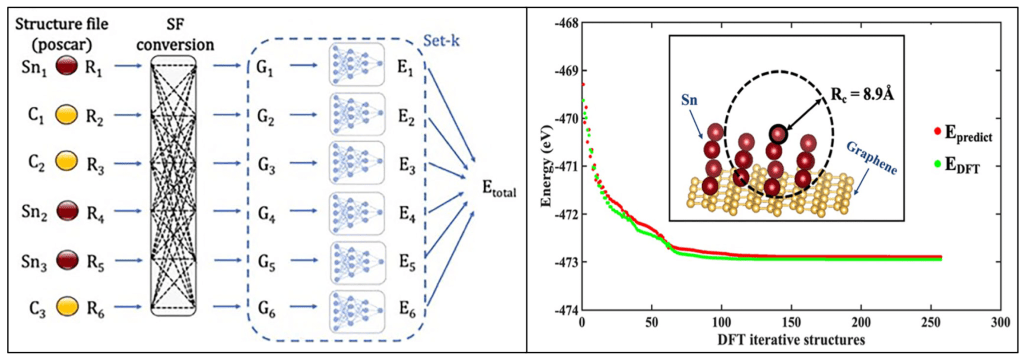
There are thousands of papers on applying machine learning to predict materials properties, but far fewer on interfaced systems—largely due to challenges in data generation. Training such models requires data on systems like selenium on graphene or silicon on silicon. However, existing databases such as the Materials Project and OQMD do not provide interfaced data. To address this gap, generating high-quality data and creating dedicated databases for interfaced systems is urgently needed. Our group was among the first to publish work on neural networks for interfaced systems, and we are now developing advanced AI techniques to enable the efficient study and discovery of these complex systems.
** LONG-RANGE CHARGE TRANSFER IN MACHINE LEARNING **
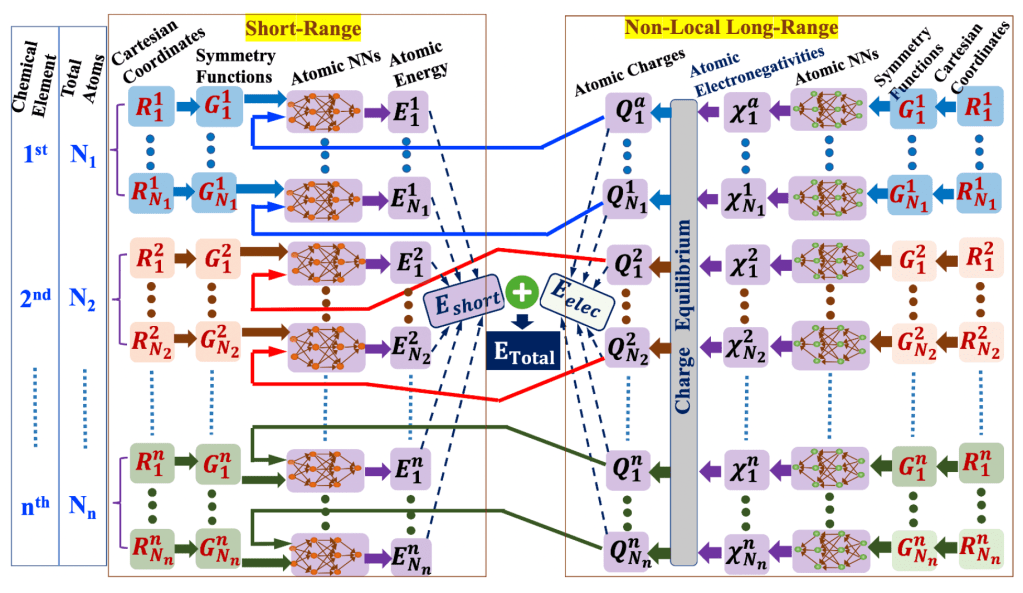
Most machine learning (ML) models in energy materials research account only for short-range charge transfer. However, atomic-level studies reveal that the charge at one end of a material can differ significantly due to surface terminations at the opposite end. Considering only the influence of neighboring atoms (short-range effects) leads to inaccurate predictions of charge (Q). Consequently, the predictions of energy (E), force (F), and stress (σ) are also unreliable, since E, F, and σ are functions of Q.
To overcome this limitation, it is essential to incorporate long-range charge transfer in the development of ML models. We briefly highlighted this important issue in a recent perspective paper. Our lab is focusing on this largely overlooked area, with the goal of enabling more accurate modeling of materials.
** GENERATIVE AI FOR DISCOVERING ENTIRELY NEW MATERIALS **

We recently published a paper on Generative AI for materials discovery. Similar to how ChatGPT generates text from a prompt, we developed a Large Language Model (LLM) trained on known materials. This model can then predict entirely new materials that do not yet exist in reality. This is THE MOST GLOBALLY COVERED JOURNAL PAPER IN THE WORLD IN 2025 🥇 #️⃣1️⃣ 🌎.
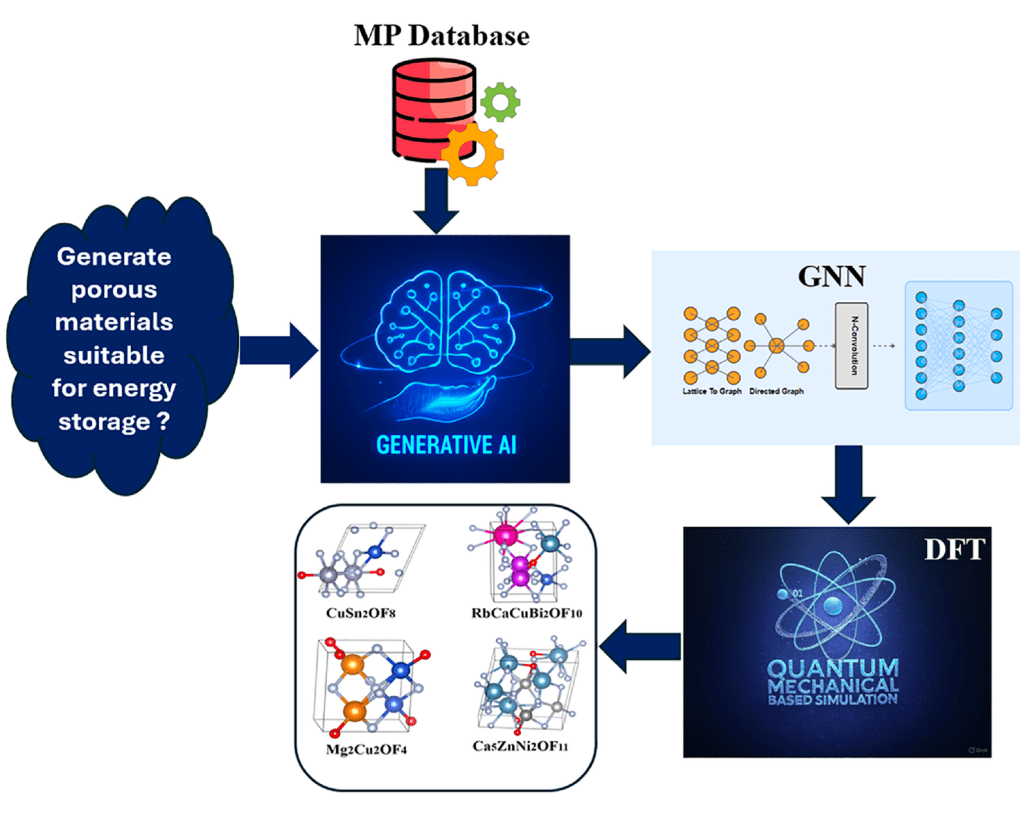
We are currently actively developing advanced Generative AI techniques for discovery of entirely new materials that don’t exist in reality for applications in various fields – energy, quantum, medicine, etc.
CLICK HERE to go back to RESEARCH page
