Research
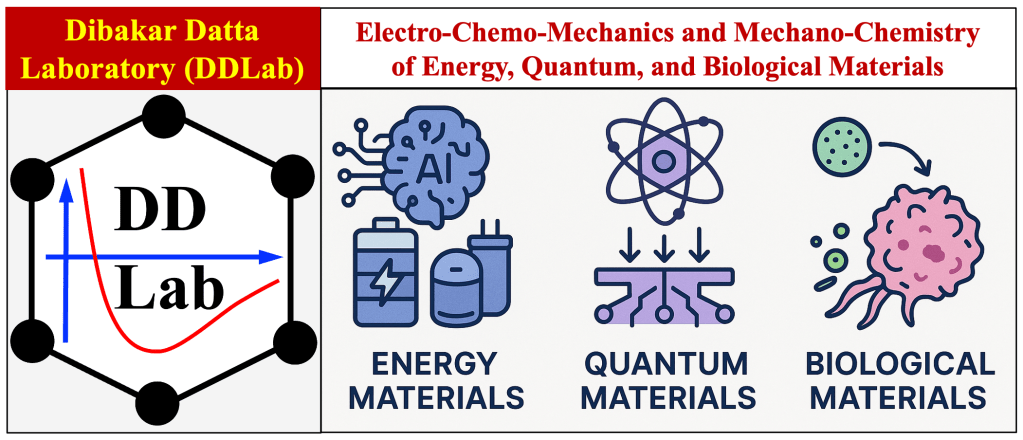
The discovery of novel materials is central to addressing urgent challenges in energy storage, quantum technologies, and biomedical science. In energy science, future batteries require materials that are lighter, cheaper, environmentally sustainable, and capable of delivering higher capacity with longer lifetimes. In quantum technologies, new quantum materials are essential for building chip-scale quantum computers that operate at ultra-low temperatures, enabling faster and more energy-efficient computation. In medical science, nanoparticles with tailored mechanical properties hold the promise of transforming cancer therapy by improving circulation, tumor penetration, and cellular uptake for efficient, low-cost drug delivery.
Despite their potential, discovering such novel materials remains profoundly difficult. Exhaustively performing density functional theory (DFT) calculations across all possible chemistries is computationally prohibitive, while molecular dynamics (MD) simulations are limited by the availability of interatomic potentials. Experimentally testing every combination is impossible. Traditional forward machine learning has improved predictions of material properties but cannot generate truly new compounds. To overcome these barriers, generative artificial intelligence (GenAI) provides a paradigm shift, enabling the creation of entirely novel materials beyond known databases.
Recently, we developed a GenAI framework that integrates a Crystal Diffusion Variational Autoencoder (CDVAE) with a fine-tuned Large Language Model (LLM) to discover porous transition-metal oxides for multivalent-ion batteries. Unlike lithium-ion systems, which rely on scarce and expensive lithium, multivalent batteries based on magnesium, calcium, or zinc are abundant and sustainable. Our approach generated thousands of candidate structures, screened them using graph neural networks (ALIGNN), and validated them with DFT. The CDVAE identified highly diverse structures, including five new oxide candidates with open-tunnel frameworks, while the LLM produced exceptionally stable structures near equilibrium—together demonstrating GenAI’s unique ability to balance stability and diversity.
Beyond Energy Science, we are currently extending this framework to design quantum materials for scalable quantum computing and nanoparticles with optimized elasticity and deformability for targeted drug delivery.
The path forward requires close collaboration between theorists, computational scientists, and experimentalists. By uniting GenAI with simulation and synthesis, we can establish a transformative pipeline from atomic-scale design to real-world applications across biomedical, quantum, and energy storage frontiers.
YouTube channel AI Handbook featured our latest research on “AI in Energy Science“. Check the video below.
CLICK HERE to go back to HOME page
